It is important to plan for many of the important events in our lives, like marriage, children, as well as retirement and leaving a legacy for our family. As you plan for your significant life events, Matt Hoesley of LifeHappens.org shares some financial steps to help secure your financial future of your family.
Create a will and contingent trust. This is one of the most important first steps. Choosing a guardian for your children helps make sure they are raised by someone who you think will share the same values. A contingent trust helps ensure that the money your child receives from all of your hard work and planning is distributed according to your wishes instead of giving them complete control over everything the minute they turn 18.
Update beneficiary forms. Make sure you double check all of your retirement plans and insurance policies so something doesn’t fall through the cracks. Many accounts with beneficiary designations never pass through your will, so it is important that these are also updated.
Begin saving for college. There are various options available. You should consult a tax advisor and financial advisor to help determine what is best suited for your family’s financial situation. I opened a 529 plan for our daughter. The money in this plan can be used at almost any accredited higher education institute in the world.
Three in four adults agree that they could benefit from guidance and answers to everyday financial questions from a professional, do you agree with them too?1
Since women control or influence the handling of the household finances, here are five things every woman should know about their finances, including a few tips from New York Life to get you started on the path to Financial Freedom.
#1 Maximize your tax credits 2:
Each year the deductible amount you can contribute to a retirement account is increased for inflation, and there are catch-up contributions for those 50 or over.
You can receive a $1000 tax credit for each of your qualifying children, in addition to each dependent’s personal exemption. Don’t forget to take this credit-it’s like receiving $1000 tax-free in your pocket, as long as your income doesn’t exceed the limitations.
The child and dependent care credit will cover up to $3,000 of qualifying expenses if you pay a babysitter or day care center so you can work or go to school.
#2 Become a S.M.A.R.T. spender:
Set S.M.A.R.T. financial goals (Specific, Measurable, Achievable, Realistic and Time bound) and create a spending plan in 4 steps3:
1. List your income
2. Compare your income and expenses
3. List your expenses
4. List your resources and set priorities
#3 Develop a savvy investment strategy:
Finding the right mix of investments depends on your available assets, your financial goals, your time horizon, and your tolerance for risk. It is important to ensure a balance between three things: liquidity, return, and risk. Start systematically investing as soon as you are able so that a reasonable amount is saved, even after just a few years. The compounding effect can help to speed up your savings4.
#4 Know your credit score:
Based on the factors below you are assigned a credit score between 300 (low) and 850 (outstanding). Here are the main areas in which you are graded and given credit scores, and the approximate weight that each area is given5:
Payment history: 35%
Outstanding debt: 30%
Credit history: 15%
New credit and types of credit: 20%
#5 You are your most important asset:
For most people, human capital is the missing piece of their portfolio. You insure your car, in the event you get into an accident. You insure your belongings, in case they’re lost or stolen. Your biggest asset is your ability to get up every day and provide for your family, whether by working or being the primary care giver. How do you insure your biggest asset? Through life insurance products.
A financial professional is trained to help you select and recommend vehicles that are suited to your protect your specific needs. You might find that working with a trained financial professional can help you to make well-informed decisions and stick with your financial plan — it is important that this is someone you are comfortable working with.
Click here to learn more about how New York Life can help you educate yourself on financial matters and set you on the path to a secure future.
Article by New York Life Insurance Company:
1 The 2014 Consumer Financial Literacy Survey, The National Foundation for Credit Counseling, http://www.nfcc.org/NewsRoom/FinancialLiteracy/files2013/NFCC_2014FinancialLiteracySurvey_datasheet_and_key_findings_031314%20FINAL.pdf
If you’re recently married, at some point you’ll be faced with a big decision: how to merge finances. (And if you’ve been married for a couple of years, but you’re finally deciding to merge finances with your spouse, this article is for you, too.) Sheiresa Ngo of Black Enterprise share five tips that will help you and your spouse work in perfect financial harmony.
Have regular meetings.
Don’t remain in the dark about your individual and household finances. Regularly meet to discuss savings goals, big purchases, and your overall progress. Write down your short-, mid-, and long-term financial goals. Make sure that you hold meetings at a time when you’re both relaxed and ready to talk.
Share your financial history.
Be open about your financial track record. Share information such as any financial snags, your salary, where you currently bank, and how much you have in your bank accounts. Honesty is the best policy. Don’t lie about extra money or secretly open up a new bank account to hide money or large purchases you didn’t discuss as a couple. This is sure to cause strife between the two of you.
Draft a plan.
Once you’ve had a few meetings and worked out the kinks, work on drafting a financial plan. This plan should include a household budget.
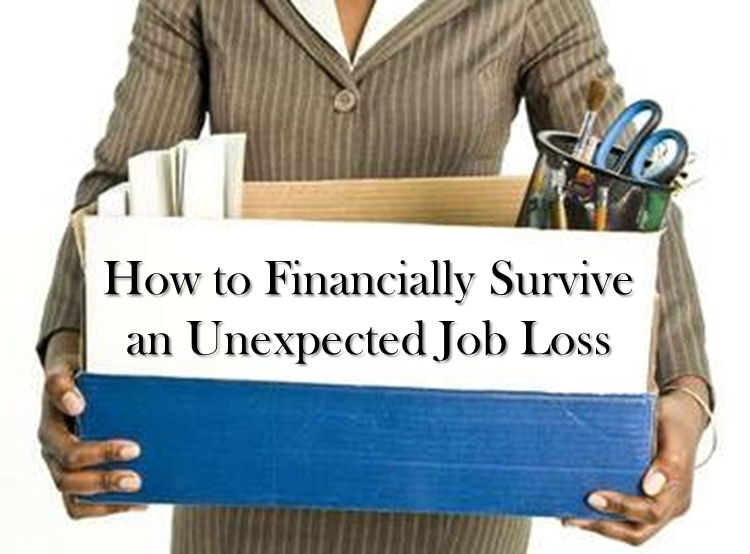
Tis the season for financial stress. Not only do many people deal with the stress of the financial burden that holiday shopping can create, the stress is magnified tremendously if there is an unexpected job loss. Here are some great tips from ModestMoney.com on how to financially survive an unexpected job loss.
Sometimes, months of layoff rumors precede a job loss. You hear whispers of cutbacks and people not getting their raises. Other offices start to close, and you’re pressured to work harder and cut costs.
At other times, a job loss happens with absolutely no warning. Your business closes, you get fired, or you become disabled and unable to work.
If you get fired or laid off, you might draw unemployment for a little while. Unfortunately, the bills won’t stop coming even when your money disappears. The last thing you want to do when the unexpected happens is to find yourself without a plan. Disaster-proof your finances now, before it’s too late.
DISABILITY INSURANCE
About 70 percent of people own life insurance policies, but only 40 percent invest in disability insurance. In reality, it’s probably more important to protect your current income before investing in life insurance. A 20-year-old today has a 30-percent chance of becoming disabled and missing at least six months of work before retirement. You might think you can fall back on government benefits for disability, but they vary widely depending on where you live. In the U.S., for example, people draw an average of just $1,188 for Social Security disability.
Disability insurance costs more than life insurance. The average private disability policy costs $18.60 per $1,000 of coverage versus 22 cents per $1,000 of coverage for life insurance. However, if you purchase disability insurance through your employer, you often get a cheaper policy. The average employer disability policy costs just $16.30 per $1,000.
Don’t worry about disability insurance if you make less than $30,000 per year or if you’re over 65. In these cases, you can get as much from public benefits as you will from your policy.
Also, if your injury results from an accident or workplace negligence, you can contact personal injury attorneys about getting a settlement. However, if you’re the family breadwinner, and you can’t live off of savings and investments if you can’t work, then you need disability insurance. Keep these tips in mind:
Pay your premium with after-tax money. When you pay disability insurance premiums with after-tax dollars, all disability benefits that you could receive become non-taxable. Even though your premiums would cost less if you paid for them with pre-tax income, you’d save a lot of money — if you actually became disabled — by making sure that you don’t owe taxes on the payouts you receive.
Expect only partial income replacement. Most disability payouts cover only 50 to 70 percent of your salary. Again, you can bridge the coverage gap by making sure that your payouts aren’t taxable. Pay your premiums with after-tax dollars.
Find ways to lower costs. You can pay lower premiums by accepting a lower percentage of your salary, such as 50 percent instead of 70 percent. Also, you can pay less by accepting a longer waiting period for payments to begin, such as accepting a 90-day waiting period instead of a 30-day waiting period.
One of the killers of a budget is overspending. Leslie E. Royal of Essence.com, shares easy ways to eliminating overspending. Check it out.
As the holidays quickly approach and the shopping season swings into full gear, companies will be creating advertisements designed to grab your attention and convince you to buy their products. If you tend to overspend, this article will help address underlying issues that trigger this behavior and get you on the road to being “in the black” for 2015.
The first step to take to stop the bleeding and get out of the red in your financial life is to be honest with yourself. Admit this is a problem for you, talk to someone about it and seek help from an accountability partner or maybe even a specialist.
“Some signs of overspending include buying things you don’t use, hiding purchases, feeling compelled to buy several of an item, going over your budget, giving gifts when others don’t reciprocate, finding yourself in a store or on a website with all of your free time and being deceptive about your finance to others,” says Dr. Sally Palaian, a licensed psychologist at the Positive Self Center and author of Spent: Break the Buying Obsession and Discover Your True Worth.
Once you acknowledge there is a problem, you can proceed to the process of elimination. Create a budget and stick to it. Discontinue the use of credit cards and opt in for cash for your shopping purchases. Understand the difference between needs and wants. Keep a record of everything you spend in a small notebook, on a 3×5 card or use a mobile app. Terrence Shulman, author of Bought Out and Spent! Recovery from Compulsive Shopping and Spending, says practical strategies women should use are to avoid people who over shop and/or trigger you to want to shop, take along a person who is a disciplined shopper, install channel and website blockers, unsubscribe from sites, get a productive hobby or interest and seek assistance from Shopaholicnomore website.
“The urge to splurge is a craving. Cravings start in the brain and are created when ’Super Stress’ occurs,” says Gloria Arenson, a licensed marriage and family therapist and author of Born to Spend: Overcoming Compulsive Spending. “The ‘rush’ of a getting a good bargain or buying things to make yourself or others feel good is temporary feel good that keeps the spender from dealing with her real life problems.”
According to Arenson, when you have the urge to buy what you don’t need and overspend:
STOP – Think about what you are doing and make note in a journal
LOOK – For the out of control days and discover how they represent emotional tantrums
LISTEN – To what this is saying about your problems that make you feel powerless
Is Credit Appeal just as important as other characteristics of a potential mate? Based on FreeCreditScore.com‘s survey and press release, a Sexy Credit Score is just as important.
Despite all the money men and women spend trying to improve their looks and attract the opposite sex, flaunting one’s frugal qualities may prove more alluring. According to a new survey from freecreditscore.com™, men and women rank financial responsibility more important than physical attractiveness. Among women, 96 percent say financial responsibility is important, compared to 87 percent noting physical attractiveness as an important quality. Men slightly favor good looks over financial responsibility (92 percent versus 91 percent) but, on average, financial responsibility is second only to personal compatibility when picking out Mr. /Mrs. Right.
“Our survey shows most people consider a partner’s ability to manage money before saying ‘I do,’” said Ken Chaplin, senior vice president at freecreditscore.com. “Women are clearly more focused on this than men, but a lot of guys say they are thinking about things like the future co-signing of loans or how one partner’s bad credit score may impact the other. It makes sense in this economy that we see increased scrutiny from both men and women; a low credit score is a warning of potential problems down the road, after vows are exchanged.”
Key highlights of the research:
Women find financial responsibility (96 percent) more attractive in assessing a romantic partner than physical attractiveness (87 percent) or career ambition (87 percent).
Credit scores are significantly more important to women (75 percent) than men (57 percent).
Women rank financial compatibility and sex/intimacy (96 percent) equally as important when considering a long term partner.
Women view “is financially responsible” (95 percent) and “pays bills on time” (92 percent) as the top two financial attributes when evaluating a romantic prospect’s attractiveness. Collectively, men and women view “spends beyond means” (88 percent) and “has debt” (52 percent) as the least attractive attributes.
Survey methodology The data points referenced above come from a study commissioned by ConsumerInfo.com, Inc., an Experian company, produced by research firm Edelman Berland and conducted as an online omnibus survey among a nationally representative sample of 1,000 American adults ages 30 to 49 (500 men, 500 women). Interviewing took place from June 12–17, 2013. The margin of error is plus or minus 3.1 percent.
About freecreditscore.com freecreditscore.com is part of a family of online consumer credit reporting sites belonging to ConsumerInfo.com, Inc., an Experian company. ConsumerInfo.com, Inc. was founded in 1995 to give consumers quick, easy and inexpensive access to their credit profile. It is now the leading provider of online consumer credit reports, credit scores, credit monitoring and other credit-related information. ConsumerInfo.com, Inc. provides credit monitoring to its more than 11.2 million members and has delivered more than 185 million credit reports to consumers. As part of the Experian family, it continues to grow its membership base and develop innovative products to help consumers better understand their credit.
This press release is provided for general guidance and information. It is not intended as, nor should it be construed to be legal, financial or other professional advice. Please consult with your attorney or financial advisor to discuss any legal issues or financial issues involved with credit decisions.
About Tarra Jackson
Tarra “Madam Money” Jackson is a financial educator, international speaker, author, and wealth empowerment strategist helping you heal, build, and grow your wealth.
We use cookies to ensure that we give you the best experience on our website. If you continue to use this site we will assume that you are happy with it.














You must be logged in to post a comment.