Category

Student Loans

FHA New Rules May Make Getting A Mortgage More Difficult for People with Student Loans

By Debt Management, Money Management, Real Estate, Student Loans No Comments

Most people that know me know that I love movies! I especially love the romantic comedy, While You Were Sleeping.”  However, there was nothing romantic or funny about the Federal Housing Administration (FHA) new rules that may make it more difficult for first-time and repeat home buyers to qualify for a mortgage.

Student-Loan-Debt-Collectors-student-loan-lawyerWhile you were sleeping …

On September 15, FHA’s new rule became effective to include deferred student loans in the debt to income (DTI) ratio that lenders use to determine whether a borrower can repay a mortgage.

Prior to September 15, 2015, FHA allowed loan officers to exclude student loans in deferment for at least 12 months from the total debt when calculating the debt-to-income (DTI) ratio.

Wait! … What?

Yup! That’s right! Under the new FHA rule, loan officers are now required to use 2 percent of the outstanding deferred student loan balance in calculating the monthly DTI. For example, if you have a deferred student debt balance of $20,000, FHA will now include a 2 percent ($400 a month) repayment obligation when calculating your DTI.

Why … Why … WHY?!?

Research by the Federal Reserve Bank of New York revealed that at the end of 2014, 43 million people, most of them younger than 40, had an estimated $1.2 trillion in outstanding student-loan debt, with an average balance close to $27,000.  Alarmingly, 17 percent of borrowers are delinquent or in default, and although 20 percent are current on payments, they have experienced delinquencies in the past.

Brian Sullivan, an FHA spokesman, told Ken Harney of the Washington Post, “Deferred student debt is debt all the same and really must be counted when determining a borrower’s ability to sustain both student debt payments and a mortgage over the long haul.” He added that the agency’s primary goal is to put first-time home buyers “on a path of sustainable homeownership rather than being placed into a financial situation they can no longer afford once their student debt deferment expires.”

What this means to you …

This rule change may “make FHA loans, which traditionally have been the go-to financing source for young, first-time and moderate-income purchasers, less attractive” say mortgage lenders and analyst.

The 2 percent calculation is more than the amount that Fannie Mae and Freddie Mac use, which is 1 percent. If your student loan is not deferred, the actual monthly payment is included with your total debt. This may affect the amount of mortgage you qualify for or whether or not you qualify for a mortgage at all.

And … There’s more!

There are also new rules regarding down payment gifts that could complicate things for you as well… (Continue reading “New rules make it tougher for people with college loans to buy houses” by Ken Harney, WashingtonPost.com)

[us_separator icon=”fas|dollar-sign” type=”default”]

How America Pays for College

By College, Money Management, Student Loans No Comments
[us_separator type=”invisible” icon=”fas|star”]

Figuring out how to pay for college can be a challenge. You know other families accomplish it, but how?

How America Pays for CollegeThat’s the question asked — and answered — in the annual study, How America Pays for College. For eight years, Sallie Mae® and Ipsos have interviewed undergraduate students and parents of undergraduate students to uncover how they’re funding higher education, the choices they’re making, the value they place on education, and more. The 2015 study reveals that:

  • College spending is up. Families spent an average of $24,164 on college — including tuition, room and board, and other direct and indirect expenses. That’s 16 percent more than last year and the most significant increase in five years.
  • Mom and Dad are #1. Parent income and savings were the top source of funding, surpassing scholarships and grants for the first time since 2010.
  • Not everyone borrows. Sixty-two percent of families reported they did not borrow for college in academic year 2014-15.
  • Students are doing their part. Working students are now the norm — 74 percent of students worked at some point to help cover costs.

According to How America Pays for College 2015, families overwhelmingly agree college is a worthwhile investment and they’re willing to stretch financially to meet the cost.


See the full report and related infographic at SallieMae.com/HowAmericaPaysForCollege and join the conversation on social media at #HowAmericaPays.

[us_separator type=”invisible” icon=”fas|star”]

5 Tips for the Paying-for-College Talk

By College, Money Management, Student Loans No Comments

Paying for college may be challenging for some parents to think about or discuss. Sallie Mae shares five helpful tips on how to have the Pay-for-College Talk.

Get the facts

First, you need to know how much a year of college will cost — tuition, books, room and board, and other expenses. Once you have a number, you can begin to figure out how you’ll pay for it — or if your student needs to focus on a less-expensive school.

Make a plan

An online calculator can help you estimate costs so you can develop a plan. College Planning CalculatorSM at SallieMae.com/CollegePlanningCalc is an easy-to-use tool with an added feature for families who are considering borrowing to pay for college: important guidance on loan affordability to help them understand the impact of a monthly student loan payment on a starting salary. It includes a salary guide to help students and their families determine a manageable monthly loan payment that corresponds to the student’s anticipated annual salary.

Engage your student

Don’t make paying for college a parents-only project. If they haven’t already started, remind your student that they can save birthday and holiday gift money. Summer jobs count, too. The more they can save for college now, the less they’ll have to borrow later on.

Be open

Be honest with your student about how much you can contribute to college costs —and that they’ll be responsible for everything else, either through scholarships and grants and/or student loans. Plus, when you create your plan with the College Planning Calculator, share it with your student at each step.

Do it now

Don’t wait till acceptance letters start arriving to have the financial talk with your student. Having a plan in place and knowing how you’ll pay for college will make the overwhelming senior year an easier experience.

Create your paying-for-college plan at SallieMae.com/CollegePlanningCalc.


© 2015 Sallie Mae Bank. All rights reserved. Sallie Mae, the Sallie Mae logo, and College Planning Calculator are service marks or registered service marks of Sallie Mae Bank or its subsidiaries. SLM Corporation and its subsidiaries, including Sallie Mae Bank, are not sponsored by or agencies of the United States of America. SMSM MKT10284B 0315

Education Tax Credits and Deductions Often Overlooked

By Student Loans, Taxes No Comments
[us_separator type=”invisible” icon=”fas|star”]

Excerpt from Sallie Mae‘s Press Release

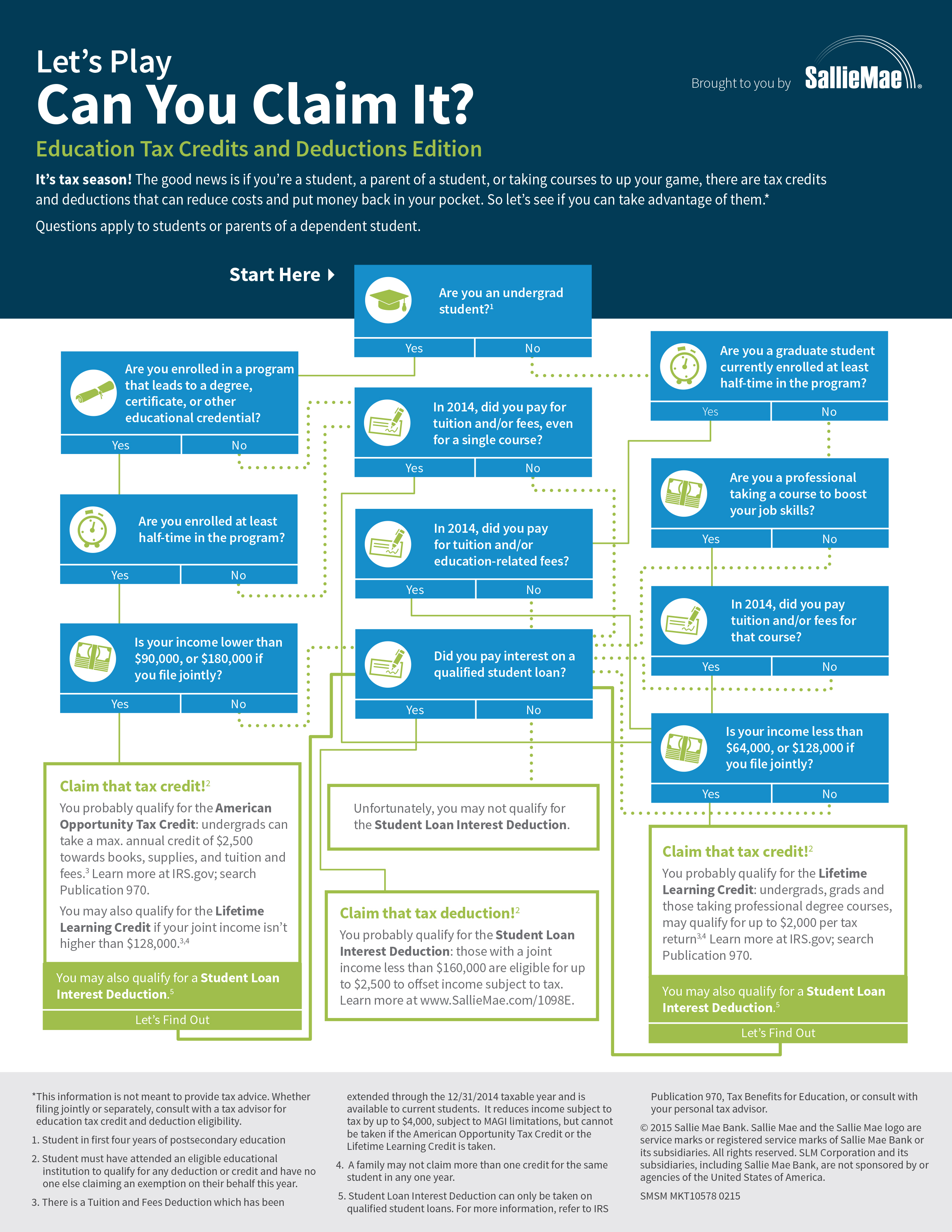
Last year, the federal government provided more than $15.6 billion in education credits and deductions with families receiving an average of about $1,200 according to The College Board. Yet, according to “How America Pays for College,” an annual study conducted by Sallie Mae and Ipsos, less than half of American families used tax credits and deductions as a way to help cover tuition costs.

education tax credits“Families tell us they don’t want to spend more on college than necessary,” said Martha Holler, senior vice president, Sallie Mae. “Higher education tax deductions and credits are an effective way to reduce your college costs, so study up and claim yours this year.”

Sallie Mae recommends students and families explore these various tax options in order to capitalize on savings.

  • The American Opportunity Tax Credit. Eligible taxpayers may qualify for a maximum annual credit of $2,500 per student. To be eligible, the student must be enrolled at least half-time in a degree or other recognized educational credential, and cannot have completed the first four years of postsecondary education before 2014. The credit can be applied to course-related books and supplies, in addition to tuition and fees. The American Opportunity Tax Credit is available to taxpayers with a joint adjusted gross income as high as $180,000.
  • The Lifetime Learning Credit. Eligible taxpayers may qualify for up to $2,000 per tax return to help pay for undergraduate, graduate and professional degree courses – including courses designed to improve job skills. There is no limit on the number of years an individual can claim the Lifetime Learning Credit. The Lifetime Learning Credit is available to taxpayers with modified adjusted gross income less than $64,000 or $128,000 if filing jointly. A family may not claim more than one credit for the same student in any one year.
  • Student Loan Interest Deduction. Student loan borrowers are eligible for up to $2,500 in student loan interest deductions to offset income subject to tax. Available for both federal and private education loans in repayment, those with a joint modified adjusted gross income less than $160,000 qualify for this deduction.  In 2012, 10.8 million taxpayers deducted $10.7 billion in student loan interest, generating about $1.7 billion in tax savings.
  • Tuition and Fees Deduction. Students and families can use up to $4,000 in expenses for higher education to offset income subject to tax.  This deduction is taken as an adjustment to income, however, an individual does not need to itemize other deductions. Individuals can file for this deduction with a joint modified adjusted gross income of up to $160,000.

When it comes to paying for college, Sallie Mae recommends families follow its 1-2-3 approach: first, maximize money that does not need to be repaid such as scholarships and grants; second, explore federal student loans; and, third, consider a responsible private education loan.

Click here to read complete Press Release