

As a Spender, I HATE the word Budget! But are they necessary? 🤷🏽♀️ Join the Great Debate about Budgeting & learn how to really take control over your cash to…
Read More

This article “Confession of a Financial Fornicator” was originally featured in Upscale Magazine’s October issue. I’m looking forward to providing financial tips and advice in upcoming issues. Also, check out my articles via UpscaleMagazine.com.
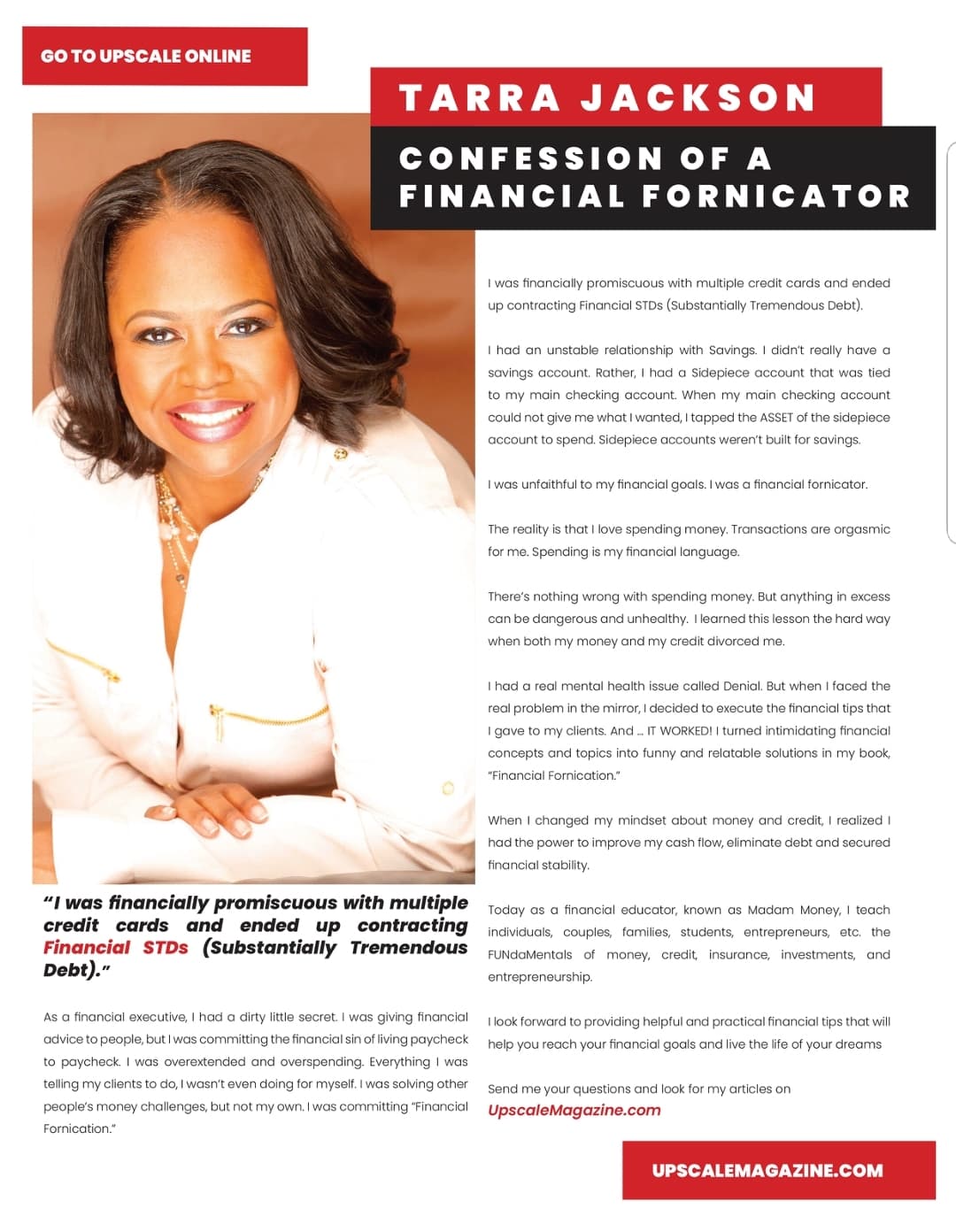
As a financial executive, I had a dirty little secret. I was giving financial advice to people, but I was committing the financial sin of living paycheck to paycheck. I was overextended and overspending. Everything I was telling my clients to do, I wasn’t even doing for myself. I was solving other people’s money challenges, but not my own. I was committing “Financial Fornication.”
I was financially promiscuous with multiple credit cards and ended up contracting Financial STDs (Substantially Tremendous Debt).
I had an unstable relationship with Savings. I didn’t really have a savings account. Rather, I had a Sidepiece account that was tied to my main checking account. When my main checking account could not give me what I wanted, I tapped the ASSET of the sidepiece account to spend. Sidepiece accounts weren’t built for savings.
I was unfaithful to my financial goals. I was a financial fornicator.
The reality is that I love spending money. Transactions are orgasmic for me. Spending is my financial language.
There’s nothing wrong with spending money. But anything in excess can be dangerous and unhealthy. I learned this lesson the hard way when both my money and my credit divorced me.
I had a real mental health issue called Denial. But when I faced the real problem in the mirror, I decided to execute the financial tips that I gave to my clients. And … IT WORKED! I turned intimidating financial concepts and topics into funny and relate-able solutions in my book, “Financial Fornication.”
When I changed my mindset about money and credit, I realized I had the power to improve my cash flow, eliminate debt and secured the financial stability.
Today as a financial educator, known as Madam Money, I teach individuals, couples, families, students, entrepreneurs, etc. the FUNdaMentals of money, credit, insurance, investments, and entrepreneurship.
I look forward to providing helpful and practical financial tips that will help you reach your financial goals and live the life of your dreams.
Send me your questions and look for my articles on UpscaleMagazine.com.
Click here to subscribe to Upscale’s Lifestyles Newsletter for FREE to access my articles and tips as well at https://tinyurl.com/upscalenewsletter.

A reader sent in this interesting question and I thought I would share a tip that will not only help them save their money but help to improve their credit at the same time.
“Madam Money, I work in sales and I just found out that I will be getting a $19,000 bonus for the last sales quarter! I feel so blessed! I don’t really have that much debt to pay off BUT I have wanted to build a backyard deck. About a year ago I got estimates for when I was ready and able to have it built. The lowest bid was around $10,000. I also wanted a surround sound system since I do a great deal of entertaining at my home. I know during this economy I should save my money but I feel that I deserve to do something special for myself since I busted my butt last quarter. What do you suggest? Should I use my bonus to get what I want or should I bite the bullet and save it?” – Ready to Spend, Union City, GA
Dear “Ready to Spend,”
Congratulations on your healthy bonus! You are truly blessed and are obviously great at what you do. It is also great that your debt is not so overwhelming to have to use your bonus to pay it down or in full.
I will NOT tell you NOT to spend you money! If you are a Spender and I tell you not to spend, you will more than likely feel deprived, rebel and possibly spend more than you want or spend it all.
For example, I don’t do Diets. When I hear DIET, I hear “DIE” … deprivation. And, when I feel deprived (and can’t have a Big Mac), I rebel. So instead of having a Big Mac once a month, I may have one once a week just to not feel deprived. Same thing happens psychologically with Spenders regarding money!
I WILL tell you to apply your Spending Plan allocations to your bonus. At the very least, take 5% of the bonus for your play money and get what you want and put the 95% of the bonus in a high yielding interest bearing savings account or CD (certificate of deposit).
OR, if you are really inclined to build that desired backyard deck, put the bonus in a high yielding interest bearing savings account and use the money as collateral for a Secured Loan.
A Secured Loan will provide you the following benefits:
A Savings (or “Share” if it is a credit union) or CD Secured Loan from a financial institution usually has an easy or guaranteed approval process. A Secured Loan is little to no risk to the financial institution because if you should default (not pay) on the loan, they can take the money in the savings to pay it off. Do don’t default if you want to keep your hefty nest egg.
Some financial institutions may offer below market interest rates for secured loans. For example, 3.00% above the savings/cd rate would be 3.00% + 0.50% = 3.50% interest rate. Make sure you shop around. Credit Unions may have competitive Share/Savings Secured Loan Rates.
If you have “colorful” or no credit, a secured loan is a great way to add a positive credit account on your credit report to assist in improving your credit score.
Although your funds may be on hold (unavailable to withdrawal), when the secured loan is paid in full, you still have YOUR MONEY in your savings account or CD. And an added bonus is that it will have earned interest.
Which ever option you choose, be wise about your decision and DO NOT spend all of your cash! Cash is leverage, especially when your credit may be “colorful” and your “credit score” may not be as SEXY as you would like it to be.
My book, Financial Fornication, discusses “Spending Plan Allocation” to help ensure all areas of your expenses have the appropriate allocation of your net income.
Again, congratulations and enjoy your new deck or new sound system and growing savings account!!!
– Tarra Jackson, Madam Money
Do you have a financial question you need real, practical answers to? Ask Madam Money by emailing your questions to info@MadamMoney.com.


Three in four adults agree that they could benefit from guidance and answers to everyday financial questions from a professional, do you agree with them too?1
Since women control or influence the handling of the household finances, here are five things every woman should know about their finances, including a few tips from New York Life to get you started on the path to Financial Freedom.
Each year the deductible amount you can contribute to a retirement account is increased for inflation, and there are catch-up contributions for those 50 or over.
Set S.M.A.R.T. financial goals (Specific, Measurable, Achievable, Realistic and Time bound) and create a spending plan in 4 steps3:
1. List your income
2. Compare your income and expenses
3. List your expenses
4. List your resources and set priorities
Finding the right mix of investments depends on your available assets, your financial goals, your time horizon, and your tolerance for risk. It is important to ensure a balance between three things: liquidity, return, and risk. Start systematically investing as soon as you are able so that a reasonable amount is saved, even after just a few years. The compounding effect can help to speed up your savings4.
Based on the factors below you are assigned a credit score between 300 (low) and 850 (outstanding). Here are the main areas in which you are graded and given credit scores, and the approximate weight that each area is given5:
For most people, human capital is the missing piece of their portfolio. You insure your car, in the event you get into an accident. You insure your belongings, in case they’re lost or stolen. Your biggest asset is your ability to get up every day and provide for your family, whether by working or being the primary care giver. How do you insure your biggest asset? Through life insurance products.
A financial professional is trained to help you select and recommend vehicles that are suited to your protect your specific needs. You might find that working with a trained financial professional can help you to make well-informed decisions and stick with your financial plan — it is important that this is someone you are comfortable working with.
Click here to learn more about how New York Life can help you educate yourself on financial matters and set you on the path to a secure future.
Article by New York Life Insurance Company:
1 The 2014 Consumer Financial Literacy Survey, The National Foundation for Credit Counseling, http://www.nfcc.org/NewsRoom/FinancialLiteracy/files2013/NFCC_2014FinancialLiteracySurvey_datasheet_and_key_findings_031314%20FINAL.pdf
2 http://www.wife.org/taxstrategiesforwomen.htm
3 http://www.pacer.org/publications/possibilities/make-a-spending-plan/68-make-a-spendingplan.html
4 Systematic investment techniques do not assure a profit or protect against a loss.

One of the killers of a budget is overspending. Leslie E. Royal of Essence.com, shares easy ways to eliminating overspending. Check it out.
 As the holidays quickly approach and the shopping season swings into full gear, companies will be creating advertisements designed to grab your attention and convince you to buy their products. If you tend to overspend, this article will help address underlying issues that trigger this behavior and get you on the road to being “in the black” for 2015.
The first step to take to stop the bleeding and get out of the red in your financial life is to be honest with yourself. Admit this is a problem for you, talk to someone about it and seek help from an accountability partner or maybe even a specialist.
“Some signs of overspending include buying things you don’t use, hiding purchases, feeling compelled to buy several of an item, going over your budget, giving gifts when others don’t reciprocate, finding yourself in a store or on a website with all of your free time and being deceptive about your finance to others,” says Dr. Sally Palaian, a licensed psychologist at the Positive Self Center and author of Spent: Break the Buying Obsession and Discover Your True Worth.
Once you acknowledge there is a problem, you can proceed to the process of elimination. Create a budget and stick to it. Discontinue the use of credit cards and opt in for cash for your shopping purchases. Understand the difference between needs and wants. Keep a record of everything you spend in a small notebook, on a 3×5 card or use a mobile app. Terrence Shulman, author of Bought Out and Spent! Recovery from Compulsive Shopping and Spending, says practical strategies women should use are to avoid people who over shop and/or trigger you to want to shop, take along a person who is a disciplined shopper, install channel and website blockers, unsubscribe from sites, get a productive hobby or interest and seek assistance from Shopaholicnomore website.
“The urge to splurge is a craving. Cravings start in the brain and are created when ’Super Stress’ occurs,” says Gloria Arenson, a licensed marriage and family therapist and author of Born to Spend: Overcoming Compulsive Spending. “The ‘rush’ of a getting a good bargain or buying things to make yourself or others feel good is temporary feel good that keeps the spender from dealing with her real life problems.”
According to Arenson, when you have the urge to buy what you don’t need and overspend:
STOP – Think about what you are doing and make note in a journal
LOOK – For the out of control days and discover how they represent emotional tantrums
LISTEN – To what this is saying about your problems that make you feel powerless
TAKE ACTION – Plan to keep track of (continue reading How to Stop the Bleeding: Eliminating Overspending by Leslie E. Royal)


© 2026 Madam Money®. All Rights Reserved. | Designed by SRJWebsites.com


You must be logged in to post a comment.