Financial Freedom means different things to different people. For some financial freedom may be having a significant savings for emergencies or retirement, paying off debt and living debt free, or ownership of a home or business. Whatever Financial Freedom may mean to us, individually; there is a common fundamental financial foundation that must be established.
How do you eat this Fundamental Financial Foundation elephant? One bite at a time.
In response to hundreds of people across the country asking for financial help in an easy to understand and implement manner, Tarra Jackson, known as Madam Money, a seasoned financial executive and syndicated financial contributor, is introducing the 30 Days to Financial Freedom Challenge (#30D2FF).
Who Can Accept the Challenge and Participate
This challenge is a free, online financial program designed to help 1,000+ adult individuals and families who are ready to achieve their goals for Financial Freedom. Feel free to challenge your family and friends to access their Financial Freedom in 30 days.
How to Accept the Challenge
To accept and participate in the 30 Days to Financial Freedom Challenge, simply
Text 30D2FF to 313131 for Financial Freedom Simple Tasks Text Alerts.
When does the Challenge Start
The Challenge begins on Monday, May 4, 2015. Participants will receive a simple task to complete via email or text alert each week day for 6 weeks to help them work towards their financial freedom. The challenge also gives participants helpful lessons and resources to help them on their journey.
We look forward to connecting, sharing and reaching Financial Freedom with you.
Setting priorities is an essential step toward gaining control of your financial life because if you don’t identify your own priorities, legions of others will be happy to fill that void by telling you about priorities for your money that are important to them.
For example, it’s important to someone that you:
Care about the labels on your clothing
Max out your credit cards for Christmas gifts and then take most of the year to pay them off
Purchase diamond jewelry for the same gift recipient a few weeks later to prove again that you really, really love her
Order products you see on infomercials
Buy a new automobile every few years
Fill your home with useless plastic trinkets
Own a larger flat screen TV you can possibly afford
Are those the priorities you have for your own life? Some of them may be, but other goals might feel even more important:
Control your time
Own your home
Get free of debt
Retire comfortably
See the world
Contribute to a cause you believe in
There’s no reason you can’t have anything (or everything) on either list above if you consciously decide you want it and are willing to put in the effort. The trick in our ad-saturated, media-driven world is to keep your own attention on that decision long enough to take the many small steps necessary to get there.
That’s where personal marketing comes in. Once you’ve identified your financial priorities, Take Back Your Brain! suggests that you go one step farther and create a marketing campaign to remind yourself about them.
What this means is that you create images of yourself having the life you want and then find ways to expose yourself to them automatically. Just like the commercial advertisers do, any way you can get the marketing messages in front of yourself is fair game. So use screen savers, slide shows, computer wallpaper, the bathroom mirror, digital photo frames, text messages, voice messages, clothing, rear view mirror, the refrigerator — anything you can think of to expose yourself to your own advertising many times a day.
Once they’re in place your “ads” compete with the flood of other input you receive every day to remind you about your priorities. Each time I see one of these pictures it brings my attention back for a moment to something important I have chosen for my own life. Soon I notice myself thinking of ways I could get there. And over time, I take more action (and therefore get better results) on priorities I advertise for, than those I don’t.
These personal ads are even more powerful if you find an emotional hook for your goal. So when you’re filling out a priorities worksheet, I recommend that you make an extra column (along with Priorities, Need or Want, and Rank) and write down why you want each priority on your list. Later you can shamelessly exploit that underlying desire to fuel your personal marketing campaign.
To read more about how to create marketing for yourself, Lynn invites you to visit Take Back Your Brain!
Did you know that being organized saves you money?
You waste money buying duplicates of items you didn’t know you had
You waste money on late charges because you can’t find the bills you need to pay, or you forget to pay them on time
You also waste money not deciding in the store where you should store the item you’re thinking of buying, and then not using it
So now that you know why you should get organized, let’s discuss some practical tips to show you how you can get your finances organized.
It’s a big myth that organizing is difficult and time-consuming.
Yes, you do have to take some time initially to set up your system but unless you want to make things really complicated, it’ll only take you about 15 to 30 minutes.
1. Put all bills to be paid in a specific folder
When you bring in the mail, throw away the junk mail and envelopes immediately and only keep the actual bill in a dedicated plastic see-through envelope in a specific place. Arrange the bills in order of when they have to be paid so that the one facing you is also the most urgent bill.
This way you and the rest of your family always know exactly where to find all the bills.
2. Automate as many bill payments as possible
We live very busy lives so if you don’t have to think about paying it, all the better for you. That said, schedule a day of the month to check your online payments against your actual budget.
3. Dedicate a specific day or days of the month to pay your bills.
Mark off a date on your calendar when you pay bills. If your bills are due on different days of the month, you may need more than one date.
Because life happens, schedule the date a couple of days before the payment is actually due so you don’t incur any late fees.
4. File
Once your bills are paid, file them in the way that’s easiest for you to manage. If you’re not a file puncher, don’t fool yourself that you will start punching and filing. The road to hell is paved with good intentions! 🙂
Rather use a filing system where you simply drop the paper in and it’s done.
5. Maintain
Restrict your filing space so that it forces you to clear out old bills every 6 – 12 months.
I actually only keep my own bills for 3 months because I have all my household categories in one file binder.
This easy-to-use system will take you only a minute or two a day, and about 30 minutes when you sit down and pay your bills.
Kim McGrigg of Money Management, International compiled this helpful information from an interview with Marcia Francois. Marcia Francois is a time management and organizing coach who empowers small business owners and other busy professionals who want to make the most of their time. You’ll get simple, practical organizing and time management secrets to help you work less and enjoy life more! Visit her website at www.takechargesolutions.org.
In his 2014 State of the Union address, President Barack Obama announced the introduction of the MyRA plan, as a way to get more Americans to begin saving for retirement. What does this mean for your investments? Can you open a MyRA account before the end of the year to take advantage of tax benefits? In this article Investorjunkie.com explains what the MyRA plan is, as well as the pros and cons to help you decide if it will be right for your retirement plan.
What is a MyRA Account?
MyRA is short for My Retirement Account. The plan will be offered through employers, but isn’t something they’ll maintain the way they do with 401(k) plans.
The program is targeted at people who have no other savings accounts for retirement. It’s thought by creating an advantageous program for low-income earners, and those who do not have the availability of an employer-sponsored plan, it will help kick-start retirement savings across the country.
The program is intended to be an entry-level retirement plan, which will eventually get investors interested in moving up to more traditional plans.
As it is designed, MyRAs will have some similar features to Roth IRAs, but enough variations that it will be an entirely new program.
The plan details are expected to be finalized by December 31, 2014 and is being rolled out this year as a pilot program with limited participation. It will be available only to those who are not currently covered by employer-sponsored retirement plans, and only to people in households earning less than $191,000 per year.
Eventually, however, it’s expected to be extended to low- and middle-income households who do have an employer plan.
How Does a MyRA Account Work?
Not a lot of detail is yet known about the plan. But as it stands now, MyRAs are to be set up with similar characteristics to Roth IRAs:
Maximum contribution is $5,500 per year
Like a Roth IRA, contributions are not tax deductible when made, but investment earnings accumulate on a tax-free basis
Also like a Roth, the money withdrawn is taken out tax-free
Contributions can be withdrawn any time, but investment income taken out before age 59 ½ will be subject to taxes and penalties
So far, so good. But here’s where a MyRA account shifts gears:
The account will be held with your employer, who will “neither administer the accounts nor contribute to them”
The accounts will be fully transferable from one employer to another
You will not have a choice as to how the money in the account is invested
There is no risk of principal loss, as it is guaranteed by the U.S. Government
There will be no administrative fees on the accounts
Accounts can be opened with as little as $25, and funded with contributions as low as $5 per paycheck
The income limit on the program is $191,000
Eventually you’ll be able to make contributions even if you’re covered by another retirement plan
The account must be rolled over into a regular Roth IRA once the account is 30 years old, or the balance reaches $15,000
As more info becomes available, we’ll continue updating this post.
The Case FOR a MyRA Account
If you cannot have an employer-sponsored retirement plan, or have not been able to save for retirement for any reason up to this point, a MyRA account may be an excellent option. It will at least get you started with retirement savings, and for many people that’s the single biggest obstacle.
Another major plus for the plan is investing is completely risk-free. The money will be invested in U.S. government securities, which guarantees repayment of principal. You’ll be able save money without fear of loss — which is another reason low-income people fail to save and invest for retirement.
There’s also the obvious advantage of being able to open the account with very little money, and to fund it with just five dollars per paycheck. Since IRA plans typically require contribution minimums of $50 or more, this should prove to be a major plus for low-income investors.
The Case AGAINST a MyRA Account
While MyRA accounts definitely have certain appeal to people who have not saved for retirement, there will be very little incentive for those who already are.
If you’re recently married, at some point you’ll be faced with a big decision: how to merge finances. (And if you’ve been married for a couple of years, but you’re finally deciding to merge finances with your spouse, this article is for you, too.) Sheiresa Ngo of Black Enterprise share five tips that will help you and your spouse work in perfect financial harmony.
Have regular meetings.
Don’t remain in the dark about your individual and household finances. Regularly meet to discuss savings goals, big purchases, and your overall progress. Write down your short-, mid-, and long-term financial goals. Make sure that you hold meetings at a time when you’re both relaxed and ready to talk.
Share your financial history.
Be open about your financial track record. Share information such as any financial snags, your salary, where you currently bank, and how much you have in your bank accounts. Honesty is the best policy. Don’t lie about extra money or secretly open up a new bank account to hide money or large purchases you didn’t discuss as a couple. This is sure to cause strife between the two of you.
Draft a plan.
Once you’ve had a few meetings and worked out the kinks, work on drafting a financial plan. This plan should include a household budget.
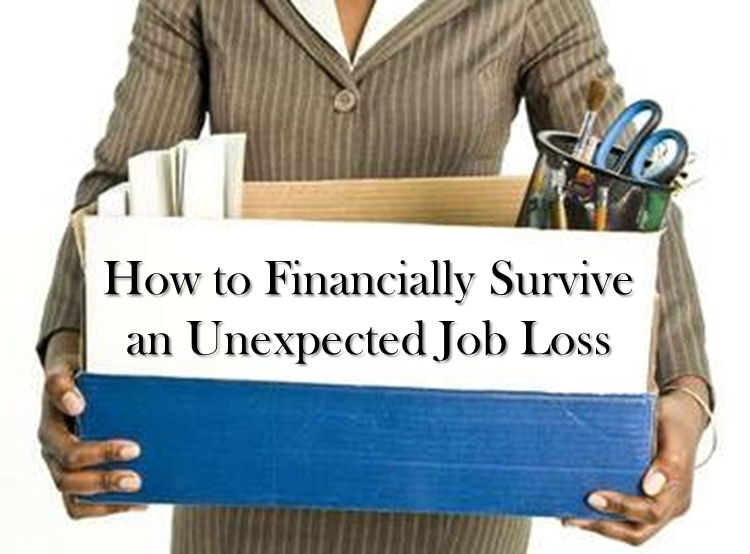
Tis the season for financial stress. Not only do many people deal with the stress of the financial burden that holiday shopping can create, the stress is magnified tremendously if there is an unexpected job loss. Here are some great tips from ModestMoney.com on how to financially survive an unexpected job loss.
Sometimes, months of layoff rumors precede a job loss. You hear whispers of cutbacks and people not getting their raises. Other offices start to close, and you’re pressured to work harder and cut costs.
At other times, a job loss happens with absolutely no warning. Your business closes, you get fired, or you become disabled and unable to work.
If you get fired or laid off, you might draw unemployment for a little while. Unfortunately, the bills won’t stop coming even when your money disappears. The last thing you want to do when the unexpected happens is to find yourself without a plan. Disaster-proof your finances now, before it’s too late.
DISABILITY INSURANCE
About 70 percent of people own life insurance policies, but only 40 percent invest in disability insurance. In reality, it’s probably more important to protect your current income before investing in life insurance. A 20-year-old today has a 30-percent chance of becoming disabled and missing at least six months of work before retirement. You might think you can fall back on government benefits for disability, but they vary widely depending on where you live. In the U.S., for example, people draw an average of just $1,188 for Social Security disability.
Disability insurance costs more than life insurance. The average private disability policy costs $18.60 per $1,000 of coverage versus 22 cents per $1,000 of coverage for life insurance. However, if you purchase disability insurance through your employer, you often get a cheaper policy. The average employer disability policy costs just $16.30 per $1,000.
Don’t worry about disability insurance if you make less than $30,000 per year or if you’re over 65. In these cases, you can get as much from public benefits as you will from your policy.
Also, if your injury results from an accident or workplace negligence, you can contact personal injury attorneys about getting a settlement. However, if you’re the family breadwinner, and you can’t live off of savings and investments if you can’t work, then you need disability insurance. Keep these tips in mind:
Pay your premium with after-tax money. When you pay disability insurance premiums with after-tax dollars, all disability benefits that you could receive become non-taxable. Even though your premiums would cost less if you paid for them with pre-tax income, you’d save a lot of money — if you actually became disabled — by making sure that you don’t owe taxes on the payouts you receive.
Expect only partial income replacement. Most disability payouts cover only 50 to 70 percent of your salary. Again, you can bridge the coverage gap by making sure that your payouts aren’t taxable. Pay your premiums with after-tax dollars.
Find ways to lower costs. You can pay lower premiums by accepting a lower percentage of your salary, such as 50 percent instead of 70 percent. Also, you can pay less by accepting a longer waiting period for payments to begin, such as accepting a 90-day waiting period instead of a 30-day waiting period.
Tarra “Madam Money” Jackson is a financial educator, international speaker, author, and wealth empowerment strategist helping you heal, build, and grow your wealth.
We use cookies to ensure that we give you the best experience on our website. If you continue to use this site we will assume that you are happy with it.




 Who Can Accept the Challenge and Participate










You must be logged in to post a comment.