Category

Credit

5 Quick Financial Survival Tips for the Recently Divorced

By Credit, Debt Management, Loans, Money Management No Comments


Are you (or someone you know) recently divorced? I’m not … but I’ve worked with several clients who are.

If are recently divorced, you may be feeling not just the loss of a partner, but also the absence of the second paycheck. Chances are, you have been living a lifestyle based on two incomes, and now that you are the sole provider there are some changes that will need to be made. First important thing is to determine what you can live on by compiling your household and other bills and adding them up, including your food and gas expenses. Then try these 5 Quick Financial Survival Tips for the Recently Divorced.

Downsize Housing or Seek Assistance

If your rent is more than you can handle, you can search for a smaller more affordable apartment. Or if you can’t afford your mortgage alone, you can try to refinance or put the home on the market for sale. Consult with a real estate professional to help you through the process in the event a Short Sale is necessary. There are also nonprofit organizations that provide assistance with foreclosure prevention.

Reduce Cable & Cell Phone Bills

There are some quick things you can do to help you through the first year, such as reducing your cable and cell phone bills. Many of us have more channels than we watch, and now would be a good time to check to see what you are paying for and remove any channels or extra cable boxes that you do not need. Change your cell phone plan to basic usage, if possible.  However, if your cell phone is your primary telephone, have your cell phone usages evaluated to find a better or more affordable plan. Also, removing any extra features and also choosing a plan with fewer minutes. Cancel your landline telephone service, if it is rarely used.

Shop Smaller Portions

Shopping for groceries may take some getting used to, especially if you have been in a relationship for a long time. You may want to buy smaller packages of things such as meat, or freeze the portion that you will not use immediately. Make a list and use coupons. Eating at home and bringing your lunch to work will reduce those extra expenses.

Increase Your Income

If you find that after doing everything humanly possible you still do not have enough to live on, then you may want to take on a part-time job to offset your expenses. This may be a challenge, especially if you have children. So, consider starting your own home based business or connecting with a network marketing organization that is right for you with a good compensation plan and reasonable independent business owner investment.

Update Your Beneficiaries & Tax Withholding

One of the most common things that recently divorced people neglect to do is update their beneficiaries on their insurance policies, bank and investment accounts.  Make sure you update all financial documents that have or require a beneficiary. Also, don’t forget to update your tax withholding on your W-4 or W-9, if necessary. Consult with your personal financial team to make these changes completely and correctly. If you don’t have your own personal Financial Team, create one that consists of your favorite Banker, Insurance Agent, Investment Adviser, Tax Accountant and Financial Coach, like me, to help you through this process.


Changing your lifestyle is hard enough without having to go through a divorce. Now that it is just you, and your children if you have any, altering your budget and spending habits will help you sustain your lifestyle. Cutting back where possible and necessary will give you greater flexibility with your spending plan or budget.

[us_separator type=”default” icon=”fas|dollar-sign”]

What are some additional Financial Survival Tips for the Recently Divorced?

“What’s Your Number?” – Getting To Their Credit Score By The Third Date

By Credit, Money Management No Comments

By Credit Infocenter

There is nothing wrong with wanting to know how a potential partner handles their finances. And there’s nothing wrong with asking about it during the dating phase. But is it really okay to ask for a credit score on the first date? Many people are doing just that these days. There’s even an online dating site — CreditScoreDating.com — that incorporates credit scores into compatibility results.

With 30 percent of women and 20 percent of men saying they will not marry someone who has bad credit, it’s definitely best to get to the credit score sooner than later. But if you’re planning to ask about their credit score, do yourself (and your date) a favor and give yourself until the third date.

First Date: Avoid the Ask

Let’s face it. First dates are a dime a dozen. Whether you met online, a chance encounter, at work, or through a friend, you never know what the chemistry and communication between you will really be like until you’re in “date mode.” Why muddy the already murky waters with any extra pressure to perform?

The fact is, there are plenty of other reasons to weed out a first date mate besides their credit score. Fortunately, these are qualities you can assess through observation alone, and they need your full attention.

How’s your chemistry? Your conversation? Do they make you laugh? Do you have interests in common? Would you look forward to spending time with this person again?

Of course, these aren’t questions you need answered on the date itself. They’re things to reflect on after the fact when you’re not face-to-face trying to like them, but back on your own considering him or her from an objective, level-headed perspective.

In other words, you may not know whether you even want a second date until the first one is over, making the credit score ask on the first date most-assuredly premature and, in turn, unnecessarily uncomfortable.

Second Date: Be Open To It

You’ve already broken the ice and found yourselves on at least one of the same pages — you like each other enough to go on a second date. Granted, this is still a discovery period, but it does imply potential interest in pursuing other dates down the line. After all, the first date went well, and hopes are high the second date will go even better.

What you’ve reached at this point is a level of comfort that may include room for an exchange of your credit scores. But don’t force it, and don’t count on it. Instead, try focusing on things that should help give you a good idea of their financial life in general.

Do they rent or own their home?

If they’re renting that will tell you less about their finances than if they own. It’s possible they rent because they don’t have the credit to get a home loan, but they also may have stellar credit and just not be interested in owning a home right now. On the other hand, if they own their home, it’s probably safe to assume their credit is good.

Do they drive a brand new car or an old clunker?

This one should be considered within the context of other financial clues. Driving a brand new car probably means they have good credit, but it could also mean they live way above their means. You should know by now what they do for a living. Do the two add up? As for the old clunker, plenty of people with great credit drive their cars until they just won’t drive anymore, which could be a sign of a saver.

Does it seem like they’re spending money in a manner meant to impress you?

There’s nothing wrong with a date spending money on you. In fact, the nicer the places you go, the more likely their credit is good. But as with the brand new car, it’s always possible they’re spending (i.e., charging) beyond their means. You probably have no real way of knowing this yet, but when a date goes out of their way to show off how much they can spend, it could be a sign of spending habits that would mean trouble down the line. Again, it may be helpful to consider this within the context of what they do for a living.

Third Date: Bite the Bullet

If a bad credit score is a deal-breaker in your book, get it out of the way on the third date. By now you know mutual interest is high. To move to a fourth date is to move into pre-relationship territory. So before you let it get that far, cut to the chase.

There is no one right way to ask your date their credit score, but here’s one way to do it, which you can edit according to whatever feels appropriate and comfortable.

Somewhere in the middle of your third date, say something like, “I’ve been having so much fun with you and am really excited about getting to know you better. One thing that’s really important to me is financial compatibility, so I was wondering if we could talk about that for a little bit.” Then leave room for your date to talk, as they will hopefully share a similar interest. The conversation will likely unfold pretty naturally. If they don’t bring up their credit score first, share yours and they likely will too. If not, ask.

Note, if at any point in the conversation about finances your date becomes defensive or aggressive, and unwilling to talk about it, let it go. Whether they have shady finances they’d rather not share, or they simply aren’t comfortable discussing finances at this point, you’re both best-served continuing your search for someone with more similar sensibilities.


Syndicated from CreditInfocenter.com

5 Car Buying Tips for Women

By Credit, Loans, Money Management, Shopping 3 Comments


Are you, or someone you know, in the market to buy a new car? The Fall Season is the best time to shop for a car because the New Year models come in, and dealers give great deals for older models to make room. Buying a new car can be exciting. However, the car buying process can also be intimidating and stressful for some women. If you are in the market for a new car now or in the near future, here are some Car Buying Tips to help save money and minimize stress when shopping for your next car.

car buying tipsKNOW YOUR BUDGET

The first and most important tip is to know “How much you can afford!” Do NOT let a car dealer’s finance department or bank tell you how much you can afford. Both essentially want to ensure that you borrow as much as possible so they can make more money off of you. The more they can make you believe that you can afford, the more the car dealership will make on the car and the more loan interest income the bank will earn on your loan.

GET PRE-QUALIFIED

The best way to avoid unpleasant surprises; like, not qualifying for the amount wanted, needing a cosigner or getting a ridiculously high interest rate, is to get Pre-Qualified or Pre-Approved for an auto loan. Go to your bank or credit union to apply for an auto loan. Tell them the payment amount you can afford to pay so they can determine the total loan amount based on the interest rate and term you qualify for based on your credit. Remember, the Higher your Credit Score, the Lower your interest rate, which may increase your qualified loan amount. Adversely, the Lower your Credit Score, the Higher your interest rate may be, which may reduce the qualified loan amount and require a down payment.

RESEARCH BEFORE YOU CAR SHOP

Now it’s time to have some fun going online to search for a vehicle in your price range. Dealers with No Haggle Deals are good because they, usually, sell their vehicles below NADAguides or Kelly Blue Book (KBB) value. Next go to NADAguides or KBB website to find out and print the Trade In and Retail Values to take when you go shopping.


TAKE A MAN WITH YOU

Some people may disagree, however,  when in doubt … take a man with you to the dealership. Take your husband, a boyfriend, father, brother, uncle, male coworker or that dude from down the street. Even if he knows nothing about cars or negotiating, take a man with you when you go car shopping. If the sales person begins speaking directly to the man, play along and coach your escort in what to say or not say. You are in control of the transaction; he is just a figurehead. Although not at all dealerships … unfortunately, women are sometimes taken advantage of during the car sales process.

NEGOTIATE BEFORE THE TEST DRIVE

Sometimes we lose our mind after we get intoxicated by that “New Car” smell during the test drive. My advice is to negotiate before you test drive to have a clear mind during the negotiation process. Here are a few things to do when you get to the car dealer:

  • Tell the sales person that you are doing a cash purchase. (Because you have already been pre-approved!)
  • Do NOT give your personal information or allow them to run your credit. (Again, you are already pre-approved.)
  • Tell the sales person what type of car and the price you want.
  • Ask if the car has any rebates or if the dealership has any incentives.
  • Ask to see the buyers order with options to see the breakdown of all expenses and fees to help you with negotiating.

Use your NADA or KBB value to negotiate the price as close to the Trade-In value as possible. Negotiating the price as close to the Trade-In value will give you equity in your car, as well as help you when you decide to trade in the car later.

Even if you are not able to get your dream car now, by getting a reasonably priced vehicle within your budget, you will help save money and get that dream car in your near future. Happy Shopping!

5 things every Woman should know about … their Finances!

By Credit, Debt Management, Estate Planning, Insurance, Investments, Money Management, Retirement, Saving, Taxes No Comments
[us_separator type=”invisible” icon=”fas|star”]

Three in four adults agree that they could benefit from guidance and answers to everyday financial questions from a professional, do you agree with them too?1

Since women control or influence the handling of the household finances, here are five things every woman should know about their finances, including a few tips from New York Life to get you started on the path to Financial Freedom.

#1 Maximize your tax credits 2:

Each year the deductible amount you can contribute to a retirement account is increased for inflation, and there are catch-up contributions for those 50 or over.

  • You can receive a $1000 tax credit for each of your qualifying children, in addition to each dependent’s personal exemption. Don’t forget to take this credit-it’s like receiving $1000 tax-free in your pocket, as long as your income doesn’t exceed the limitations.
  • The child and dependent care credit will cover up to $3,000 of qualifying expenses if you pay a babysitter or day care center so you can work or go to school.
#2 Become a S.M.A.R.T. spender:

Set S.M.A.R.T. financial goals (Specific, Measurable, Achievable, Realistic and Time bound) and create a spending plan in 4 steps3:

1. List your income

2. Compare your income and expenses

3. List your expenses

4. List your resources and set priorities

#3 Develop a savvy investment strategy:

Finding the right mix of investments depends on your available assets, your financial goals, your time horizon, and your tolerance for risk. It is important to ensure a balance between three things: liquidity, return, and risk. Start systematically investing as soon as you are able so that a reasonable amount is saved, even after just a few years. The compounding effect can help to speed up your savings4.

#4 Know your credit score:

Based on the factors below you are assigned a credit score between 300 (low) and 850 (outstanding). Here are the main areas in which you are graded and given credit scores, and the approximate weight that each area is given5:

  • Payment history: 35%
  • Outstanding debt: 30%
  • Credit history: 15%
  • New credit and types of credit: 20%
#5 You are your most important asset:

For most people, human capital is the missing piece of their portfolio. You insure your car, in the event you get into an accident. You insure your belongings, in case they’re lost or stolen. Your biggest asset is your ability to get up every day and provide for your family, whether by working or being the primary care giver. How do you insure your biggest asset? Through life insurance products.

A financial professional is trained to help you select and recommend vehicles that are suited to your protect your specific needs. You might find that working with a trained financial professional can help you to make well-informed decisions and stick with your financial plan — it is important that this is someone you are comfortable working with.

Click here to learn more about how New York Life can help you educate yourself on financial matters and set you on the path to a secure future.


Article by New York Life Insurance Company:

1 The 2014 Consumer Financial Literacy Survey, The National Foundation for Credit Counseling, http://www.nfcc.org/NewsRoom/FinancialLiteracy/files2013/NFCC_2014FinancialLiteracySurvey_datasheet_and_key_findings_031314%20FINAL.pdf

2 http://www.wife.org/taxstrategiesforwomen.htm

3 http://www.pacer.org/publications/possibilities/make-a-spending-plan/68-make-a-spendingplan.html

4 Systematic investment techniques do not assure a profit or protect against a loss.

5 http://www.wife.org/features_bottomline_creditscores.htm

5 Tips on Merging Finances with Your Spouse

By Credit, Debt Management, Insurance, Investments, Money Management One Comment
[us_separator type=”invisible” icon=”fas|star”]

If you’re recently married, at some point you’ll be faced with a big decision: how to merge finances. (And if you’ve been married for a couple of years, but you’re finally deciding to merge finances with your spouse, this article is for you, too.) Sheiresa Ngo of Black Enterprise share five tips that will help you and your spouse work in perfect financial harmony.

black-couple-bills-review-620x480-300x232Have regular meetings. 

Don’t remain in the dark about your individual and household finances. Regularly meet to discuss savings goals, big purchases, and your overall progress. Write down your short-, mid-, and long-term financial goals. Make sure that you hold meetings at a time when you’re both relaxed and ready to talk.

Share your financial history. 

Be open about your financial track record. Share information such as any financial snags, your salary, where you currently bank, and how much you have in your bank accounts. Honesty is the best policy. Don’t lie about extra money or secretly open up a new bank account to hide money or large purchases you didn’t discuss as a couple. This is sure to cause strife between the two of you.

Draft a plan. 

Once you’ve had a few meetings and worked out the kinks, work on drafting a financial plan. This plan should include a household budget.

Agree on where you’ll bank. 

Take time to research the best banks for your needs. The bank where you currently do business might have worked for you individually, but (continue reading Merging Finances with Your Spouse by Sheiresa Ngo)


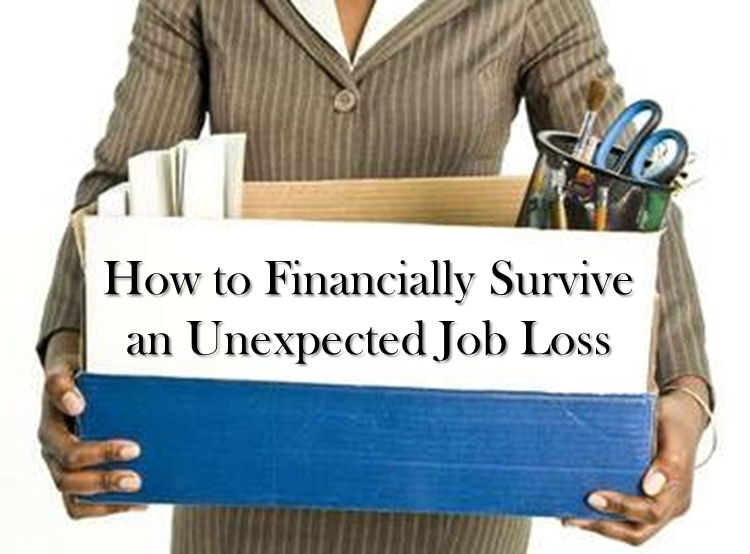
How to Financially Survive an Unexpected Job Loss

By Credit, Debt Management, Money Management No Comments

job lossTis the season for financial stress. Not only do many people deal with the stress of the financial burden that holiday shopping can create, the stress is magnified tremendously if there is an unexpected job loss. Here are some great tips from ModestMoney.com on how to financially survive an unexpected job loss.


Sometimes, months of layoff rumors precede a job loss. You hear whispers of cutbacks and people not getting their raises. Other offices start to close, and you’re pressured to work harder and cut costs.

At other times, a job loss happens with absolutely no warning. Your business closes, you get fired, or you become disabled and unable to work.

If you get fired or laid off, you might draw unemployment for a little while. Unfortunately, the bills won’t stop coming even when your money disappears. The last thing you want to do when the unexpected happens is to find yourself without a plan. Disaster-proof your finances now, before it’s too late.

DISABILITY INSURANCE

About 70 percent of people own life insurance policies, but only 40 percent invest in disability insurance. In reality, it’s probably more important to protect your current income before investing in life insurance. A 20-year-old today has a 30-percent chance of becoming disabled and missing at least six months of work before retirement. You might think you can fall back on government benefits for disability, but they vary widely depending on where you live. In the U.S., for example, people draw an average of just $1,188 for Social Security disability.

Disability insurance costs more than life insurance. The average private disability policy costs $18.60 per $1,000 of coverage versus 22 cents per $1,000 of coverage for life insurance. However, if you purchase disability insurance through your employer, you often get a cheaper policy. The average employer disability policy costs just $16.30 per $1,000.

Don’t worry about disability insurance if you make less than $30,000 per year or if you’re over 65. In these cases, you can get as much from public benefits as you will from your policy.

Also, if your injury results from an accident or workplace negligence, you can contact personal injury attorneys about getting a settlement. However, if you’re the family breadwinner, and you can’t live off of savings and investments if you can’t work, then you need disability insurance. Keep these tips in mind:

Pay your premium with after-tax money. When you pay disability insurance premiums with after-tax dollars, all disability benefits that you could receive become non-taxable. Even though your premiums would cost less if you paid for them with pre-tax income, you’d save a lot of money — if you actually became disabled — by making sure that you don’t owe taxes on the payouts you receive.

Expect only partial income replacement. Most disability payouts cover only 50 to 70 percent of your salary. Again, you can bridge the coverage gap by making sure that your payouts aren’t taxable. Pay your premiums with after-tax dollars.

Find ways to lower costs. You can pay lower premiums by accepting a lower percentage of your salary, such as 50 percent instead of 70 percent. Also, you can pay less by accepting a longer waiting period for payments to begin, such as accepting a 90-day waiting period instead of a 30-day waiting period.

SAVINGS

Traditionally, financial advisors have recommended having three to six months of income in your savings account. Unfortunately, the recession of 2007 changed a lot of the old rules. Today, 36.7 percent of people who don’t have jobs have been unemployed for more than six months. With such a tough job climate, boosting your savings rate becomes (continue reading IF YOU LOST YOUR JOB TOMORROW, WOULD YOU SURVIVE FINANCIALLY by ModestMoney.com)