All Posts By

Tarra Jackson

Tarra Jackson, known as Madam Money, is a seasoned Personal Finance Expert with over 20 years experience in the personal finance sector as a corporate trainer, loan officer, Vice President of Lending and Executive Vice President at several major financial institutions. Tarra is the author of the best-selling book “Financial Fornication” as well as a nationally acclaimed speaker, commentator, consultant, author, & syndicated blogger covering topics from cash and credit management to insurance and investment basics.

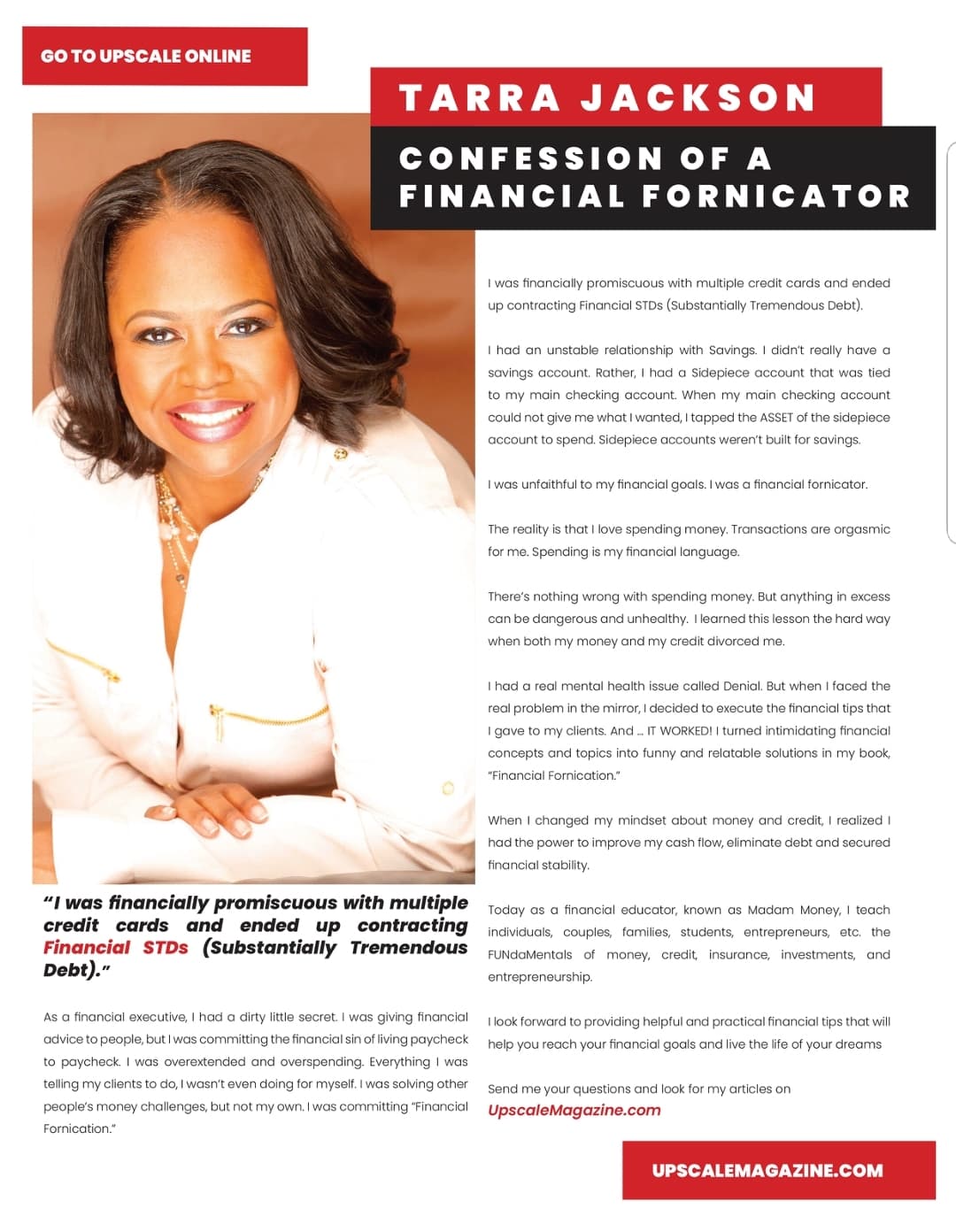
Confession of a Financial Fornicator

By Money Management No Comments

This article “Confession of a Financial Fornicator” was originally featured in Upscale Magazine’s October issue. I’m looking forward to providing financial tips and advice in upcoming issues. Also, check out my articles via UpscaleMagazine.com.

As a financial executive, I had a dirty little secret. I was giving financial advice to people, but I was committing the financial sin of living paycheck to paycheck. I was overextended and overspending. Everything I was telling my clients to do, I wasn’t even doing for myself. I was solving other people’s money challenges, but not my own. I was committing “Financial Fornication.”

I was financially promiscuous with multiple credit cards and ended up contracting Financial STDs (Substantially Tremendous Debt).

I had an unstable relationship with Savings. I didn’t really have a savings account. Rather, I had a Sidepiece account that was tied to my main checking account. When my main checking account could not give me what I wanted, I tapped the ASSET of the sidepiece account to spend. Sidepiece accounts weren’t built for savings.

I was unfaithful to my financial goals. I was a financial fornicator.

The reality is that I love spending money. Transactions are orgasmic for me. Spending is my financial language.

There’s nothing wrong with spending money. But anything in excess can be dangerous and unhealthy.  I learned this lesson the hard way when both my money and my credit divorced me.

I had a real mental health issue called Denial. But when I faced the real problem in the mirror, I decided to execute the financial tips that I gave to my clients. And … IT WORKED! I turned intimidating financial concepts and topics into funny and relate-able solutions in my book, “Financial Fornication.”

When I changed my mindset about money and credit, I realized I had the power to improve my cash flow, eliminate debt and secured the financial stability.

Today as a financial educator, known as Madam Money, I teach individuals, couples, families, students, entrepreneurs, etc. the FUNdaMentals of money, credit, insurance, investments, and entrepreneurship.

I look forward to providing helpful and practical financial tips that will help you reach your financial goals and live the life of your dreams.

Send me your questions and look for my articles on UpscaleMagazine.com.

Click here to subscribe to Upscale’s Lifestyles Newsletter for FREE to access my articles and tips as well at https://tinyurl.com/upscalenewsletter.

5 Things Keeping African Americans From Attaining The American Dream

By Money Management No Comments

For many Americans, the American Dream has been identified as home ownership. However, times have changed, as well as Americans’ definition of what they consider to be the “American Dream.” The American Dream now includes not living paycheck to paycheck, being able to travel, etc.

Today, the American Dream for African American families is financial wellness and financial freedom, with 69% being confident that it is still attainable.

Although African Americans believe that the American Dream is possible, here are 5 things keeping us from it and what we can do to get it!

Lack of an Emergency Fund

The car breaks down, someone has a medical emergency, the HVAC system goes out in the middle of summer or winter, etc. Life Happens! Whatever the emergency, having an emergency savings fund helps to protect the family’s financial foundation from these emergency bombs.

Unfortunately …

African American Families are least likely to be prepared for financial emergencies with 33% having less than 1 month of expenses saved and just 1 in 5 setting aside enough money to cover more than 6 months of expenses.

Massachusetts Mutual Life Insurance Company (MassMutual) Survey of American Families (2018)

Set an amount or percentage of the paycheck to be direct deposited into the savings account. Establishing a savings account in a different financial institution from your checking account will help to eliminate the temptation of transferring cash from the savings account. Also, establish a savings goal for a specific period (for example $1,000 in 12 months) and build from there targeting 3 to 6 months of salary for your emergency fund.

Not having both Short-Term and Long-Term Financial Goals

While 75% of African American believe that saving as much as possible and getting more educated about finances are important, 40% rely on family members for information.

This may be a challenge if the family members have limited or no financial education.

Seeking advice from family members may seem like the right thing to do, but when it comes to financial advice, it is often best to consult with a financial professional. The financial professional has a fiduciary duty (legal responsibility to take care of the client) and can guide you through the right options for your financial situation and income while making the process less intimidating and overwhelming.

Excessive Debt

Living life without using credit is ideal but not always realistic. Sometimes using credit is a useful financial tool, like buying a car or a new home.

Even though 79% of African American families say that paying down debt is a high priority, almost 70% have credit card debt, with almost half being student loans. 

This excessive debt is limiting the ability to save more for emergencies and opportunities, as well as invest more for retirement.

Focus on paying down debt using the snowball method, paying off credit cards and loans with the smallest balances or highest interest rates first. Once those debts are paid, apply the amounts of those payments towards the next debts to be paid.

Not prepared for the Unexpected

The unexpected can’t be controlled and is not something people want to think about. However, being prepared for the unexpected will help protect the family’s financial stability. The unexpected not only includes “death;” it also includes illness and accidents that result in a disability. What if a relied upon income suddenly stops? How will the family maintain household expenses, like rent/mortgage, utilities, food, etc.?

For most people, their single most valuable asset is their ability to earn an income.

Although 84% of African American families prioritize having a stable source of income for their family in case of the unexpected, most people solely rely on disability income and life insurance provided by their employer or do not own disability income or life insurance at all.

Consult with a financial professional to determine the “appropriate amounts of disability income and life insurance to protect your family’s financial stability should the unthinkable happen.”

Living Paycheck to Paycheck

For 75% of African Americans, not living paycheck to paycheck is part of the American dream. Having more month than money adds more stress to what family life may already create and living paycheck to paycheck also makes it hard to save and invest as well.

REALITY CHECK:

African American families have one of the lowest average household incomes among all ethnic groups surveyed and hold nearly the highest average credit card debt and student loan debt.

Create a budget or spending plan to determine required and unnecessary expenses, income gaps and ways to save more money and pay down debt. A budget will give you the power to make informed decisions to reach your financial goals.

By focusing on the simple strategies states above, attaining the American Dream can be attained faster towards building generational wealth.

Click here for more information regarding the Massachusetts Mutual Life Insurance Company Survey of American Families (2018).

How Self Care Can Help Make You More Money

By Money Management, Podcast One Comment

One of the most common complaints of Entrepreneurs, Solopreneurs and DUALpreneurs (full-time employee and entrepreneur) is “not having enough time.” The day is usually filled with tasks and meetings. However, one of the things left off the “To Do” List is Self Care.

In this episode of Financial Fornicating With Madam Money, successful DUALpreneur Juanita Gaynor, of EABJ Consulting & Event Management, shares 3 Ways Self Care can help you make more money as well as

  • How to maintain a healthy work-life balance as an Entrepreneur.
  • How to Build Lifestyle into Your Brand
  • How to Schedule Your Life, Not Just Work
  • How to Delegate Your Life!

About Juanita E. Gaynor

Juanita E. Gaynor is a seasoned professional in the event industry and the President & CEO of EABJ Consulting & Event Management, which is a full service special event and meeting management company that designs innovative event solutions for small to large businesses, associations, community benefit and non-profit organizations.


Thank you for listening to the “Financial Fornicating with Madam Money” Podcast!

We appreciate you listening to the Financial Fornicating with Madam Money Podcast. Please share your comments or questions about this episode below or at info@madammoney.com. Also, please share this episode using the social media buttons.

You can also listen to the Financial Fornicating with Madam Money Podcast on iTunes and Google Play Music! Please share your honest feedback as Ratings and Reviews are very helpful and greatly appreciated!

credit

3 Signs Your Worried About The Wrong S**T Regarding Your Credit

By Credit, Money Management, Podcast No Comments


Are you worried or stressed out about what is reporting on your credit report?

Since credit reports are used more and more to identify and qualify consumers for all types of services, having good, or at least fair credit, is very necessary. – @MsMadamMoney

However, if our credit is “colorful” (Ok… bad), it can inhibit access to what we need, like insurance, utilities, employment, mortgage as well as consumer credit.

Whether the trade lines (credit accounts) are reporting incorrect or outdated information; or if there accounts on the credit report that is not yours, you should be aware of what is reporting and take the appropriate action to dispute the erroneous information.

The best way to begin the process of fixing or restoring credit is to obtain free copies of the credit reports at annualcreditreport.com. It is important to understand what each credit reporting company is reporting about you, since the credit reporting companies do not report to each other.

Now, there are several legitimate concerns regarding what and how credit accounts are reporting on the three major credit reports (Equifax, Experian and TransUnion). However, some people concern themselves with the wrong things when it comes to their credit.

In this episode of Financial Fornicating with Madam Money Podcast, I share:

  • Three things to NOT stress out about when you are working to restore your credit
  • The Anatomy of the Credit Score
  • How to refocus to work on areas to help you reach your credit restoration goals


Thank you for listening to the “Financial Fornicating with Madam Money” Podcast!

We appreciate you listening to the Financial Fornicating with Madam Money Podcast. Please share your comments or questions about this episode below or at info@madammoney.com. Also, please share this episode using the social media buttons.

You can also listen to the Financial Fornicating with Madam Money Podcast on iTunes and Google Play Music! Please share your honest feedback as Ratings and Reviews are very helpful and greatly appreciated!


Episode Sponsor

This episode is sponsored by DUALpreneur.net. Are you a full-time employee and an entrepreneur? If so, you are a DUALpreneur and you understand and value the concept of Multiple Streams of Income. DUALpreneur.net provides tools, resources and services to help DUALpreneurs “Do It All, Have It All and Be It All.” For more information, visit DUALpreneur.net.

5 Ways to Avoid Financial STDs

By Credit, Debt Management, Loans, Money Management No Comments

Have you or someone you know been infected with Financial STDs? I have…   

In my book Financial Fornication, I talk about Financial STDs (Substantially Tremendous Debt).  This financial dis-ease is not only financially and emotional painful, but families and cosigners can get infected as well because it can be contagious. So, here are 5 ways to avoid Financial STDS.

Use Financial Contraception.

Financial Contraception is better known as a budget or spending plan. Create a budget or spending plan that works with your lifestyle. Using a budget is the best protection against acquiring Financial STDs.

Avoid being financially promiscuous with multiple credit cards.

Pick a credit card that has the lowest rate and provides bonus points if you must or choose to use a credit card for purchases. Using multiple credit cards may result in excessive spending, which result in Financial STDs.

Limit or Avoid Financial One Night Stands.

A financial one night stand is a financial transaction, usually less than $50-$100, that should be paid in cash or paid in full if purchased with credit. If you choose to use credit for these types of transactions, avoid turning those financial one night stands into a long term financial relationship by revolving the balance and not paying it off in full. Just “Hit it & Quit it!”

Become Financial Abstinent.

When your finances feel like they’re getting out of control, sometimes it’s best to just STOP using credit to get a handle on your finances. Being financially abstinent stops the leaks in finances so a budget can be created to build up immunity against Financial STDs.

Get out of Financially Abusive Relationships.

If you are getting your butt kicked with ridiculously high loan rates, low deposit rates, lots of fees and poor customer service, they’re probably really not that into you, which means that it’s time to plan your exit strategy from that financially abusive relationship.  You don’t have to stay. Date financial institutions to find the best one for you.

For more healthy financial tips, check out my book “Financial Fornication.”


3 Financial Tips for Recent Young Widows

By Insurance, Money Management No Comments

I recently did a radio interview where I was asked to give a young man who is a recent widow money tips. He is now a single father to three young boys and had concerns about how to deal with his new financial situation. Here is what I shared with him and the radio listeners.


Losing a loved one like a spouse, that is so significant to the family, is devastating. Adding to the responsibilities of the spouse that has past can add to the stress and fear of the new young widow. While there is so much that needs to be done to keep the family structure in place, here are 3 things to do for the household finances.

#1. Create a New Household Budget

There is either a decrease in the household income, an increase in household expenses or both. Most of the time the surviving spouse not only lose their loving partner, they may also lose the associated income that contributed to the household’s financial stability. If the late spouse was a stay at home mom or dad, new expenses like daycare or after-school care may be added to the household expenses. If this is the case, a new household budget is necessary.

Writing out all of the existing and new household expenses will help the surviving spouse make important financial decisions, like whether to downsize living expenses, cut out or reduce certain activities, or necessity of adding to their income stream.

Knowing the financial position of the family is just as important as creating and working towards financial goals.

#2. List and Prioritize New Financial Goals

The devastation of losing a spouse may pause or change your financial goals.

Once your new household budget is established and stabilized, new or modified financial goals must be executed. Financial goals, like paying off debt, saving for retirement, saving for children’s education, or that family vacation, can still happen. However, with potentially limited or reduced income, they may need to be prioritized. It’s harder to catch multiple balls thrown in the air for one person, so focus on which financial balls to catch (financial goals to work) on first, second, third, etc.

Just never stop working towards accomplishing those financial goals.

#3. Update Beneficiaries, Wills and Life Insurance

Update Beneficiaries

This is a tough one to do, especially if the loss of a spouse is recent. However, it is the best time to get it done so it won’t have to be dealt with it later or forgotten about.

Update beneficiary information on all financial, medical and employment documents.  If the child(ren) are under the age of eighteen, designate a trusted family member or friend that will carry out the wishes to financially take care of them. Or, establish a Trust and make the Trust the beneficiary. With a Trust, the Executor will legally carry out the disbursement wishes for each of the beneficiaries.

Update or Create a Will

Update the Will, as necessary, and designate a family member or friend to be the estate executor. If a will is not in place and an estate executor is not designated, it is called dying “intestate.” Which means …

“The intestacy laws of the state where you reside will determine how your property is distributed upon your death. This includes any bank accounts, securities, real estate, and other assets you own at the time of death.”

Having a Will is especially important to have if there are children so that a trusted guardian is designated to take care of them.

Click here to read “10 Easy Steps to Writing a Will.”

Update or Get Life Insurance

Life insurance can be a financial blessing by covering final expenses, paying off debt, replacing the late spouse’s income, establishing or adding to an emergency fund, retirement account or educational fund for the child(ren). However, not having life insurance can cause major financial chaos to the surviving family.

This is the time to re-evaluate existing policy(ies) to make sure it is enough for the family or to obtain life insurance to protect the family from financial hardship.

If the late spouse had life insurance, after the final expenses are handled, consider using it to fund one or a few financial goals, like debt elimination, retirement savings or children’s college fund.  Avoid spending it on lots of nice things or places that will not be beneficial to the family’s financial future.

If the late spouse did not have life insurance, follow steps one and two, then speak with a Licensed Life Insurance Agent to discuss options. Just remember that one size does not fit all when it comes to Life Insurance and the most important question that needs to be asked before shopping for life insurance is:

“What do I want the Life Insurance to do for my family and while I’m alive.”

Keep in mind that Life Insurance does not have to be death insurance. Life insurance can be a financial tool and investment to assist in reaching financial goals as well as take care of your family when you pass.

The new normal of living without the spouse is emotionally, physically, spiritually and financially draining and overwhelming. Just remember to take it one at a time and ASK FOR HELP! Your family loves and needs YOU!